

Why Freight Inflation Makes Packaging Density More Valuable Than Ever
Imagine this: Your supply chain is a high-stakes game of Tetris, where every empty space in a container isn’t just wasted, it’s burning cash. Over the past few years, freight costs haven’t just crept up; they’ve surged like a tidal wave. According to the American Transportation Research Institute (ATRI), trucking operational costs have skyrocketed more than 22% in the last two years alone, driven by everything from fuel price hikes (up 18% year-over-year as of August 2025) to persistent labor shortages and geopolitical disruptions. For OEMs and Tier suppliers, these aren’t fleeting headaches, they’re the new normal, turning transportation into a budget-devouring monster.
Yet, here’s the kicker, many companies are still packing and shipping like it’s 2019, when diesel was cheap and carriers were plentiful. That’s a costly oversight. In an era where spot trucking rates are clawing back from a 27% inflation gap since 2020, optimizing packaging density isn’t optional—it’s your secret weapon to outsmart the chaos.
Freight Inflation Exposes Inefficient Packaging Like Never Before
Remember when “air in the box” was just a minor annoyance? Those days are gone. With producer price indexes for general freight trucking climbing steadily—up about 3% from July to November 2025 alone—every cubic inch of unused space is now a silent profit killer. Low-density packaging doesn’t just inflate your bill; it amplifies vulnerabilities across the board:
- More trucks on the road: Shipping the same volume of parts could require 20-30% more vehicles, spiking fuel surcharges and exposing you to volatile spot rates that analysts predict could rise 2-6% in 2026.
- Higher cost per part: Factor in rising equipment prices from tariffs and insurance hikes, and you’re looking at per-mile costs that could climb another 4% on top of recent inflation stacks.
- Amplified handling and storage woes: Bulkier loads mean more warehouse space, more labor, and higher risks of damage—potentially adding 10-15% to logistics overhead.
- Greater volatility exposure: With fuel volatility and carrier constraints pushing rates up, inefficient packing leaves you at the mercy of market swings.
Think of it as paying premium rent for a half-empty apartment. As freight inflation persists—fueled by everything from Middle East tensions to EPA regulations—those empty spaces are getting pricier by the shipment.

Small Density Gains? They're Your Ticket to Massive Savings
You don’t need a full supply chain overhaul to fight back. Modest tweaks in packaging density can snowball into game-changing wins, especially at scale. Take a real-world example from Trillora: By optimizing designs for maximum cube utilization, one client boosted shipping efficiency by 43%, slashing 2,000 trucks from the road annually. Another hiked pallet utilization by 33%, fitting 16 cases where only 12 went before.
Here’s how it plays out:
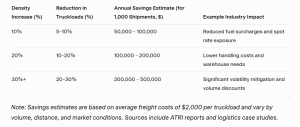
- A 10–20% bump in parts per container? Multiplied over thousands of shipments, that’s fewer truckloads—potentially cutting freight spend by 15-25% without touching lanes or carriers.
- Lighter, modular designs? They shave ounces per package, translating to thousands in annual savings on fuel and dimensional weight charges.
- Stackable innovations? Maximize trailer space, reducing per-unit costs and even earning volume discounts from carriers.
What starts as a “minor” packaging tweak compounds into outsized savings— like a global footwear producer who trimmed $1.2 million in total costs in year one through density-focused redesigns. In ITB packaging, where precision parts demand protection without bulk, these gains aren’t just nice-to-have; they’re a competitive edge.
Density: Your Shield Against Freight Market Mayhem
Freight inflation isn’t just a numbers game—it’s a rollercoaster of uncertainty. Will tariffs jack up equipment costs further? Could port strikes or oil spikes (already up 18% in 2025) derail your timelines? Higher-density packaging acts as a buffer, minimizing risks by:
- Slashing shipment volumes: Fewer loads mean less reliance on spot market chaos, where rates could spike 2-6% in 2026.
- Ditching expedites: Optimized density improves flow, cutting emergency freight that can cost 2-3 times standard rates.
- Boosting predictability: With tighter packing, you forecast transportation needs more accurately, dodging the 10-15% surcharges from last-minute carrier hunts.
When volatility hits—like the 27% inflation lag carriers are still recovering from—density keeps your costs steady while competitors scramble.
Shift Your Focus: Cost Per Part Trumps Cost Per Shipment
Old-school metrics like “cost per load” are outdated in this inflated world. The real winner? Cost per part delivered. Density supercharges this by:
- Packing more value per trip: Turn every container into a high-efficiency powerhouse, diluting freight overhead across more units.
- Easing inflation absorption: With operational costs up 22% recently, denser loads make hikes more palatable without price gouging downstream partners.
- Enhancing resilience: Lightweight, compact designs cut dimensional weight penalties, keeping per-part costs low even as carriers tweak pricing.
In ITB scenarios, where parts are often high-value and fragile, this metric reveals hidden savings—potentially 10-20% per program lifecycle.

Density: The Lever You Actually Control
You can’t dictate fuel prices (projected to remain volatile into 2026) or carrier availability. But packaging? That’s your domain. Density-optimized ITB solutions:
- Maximize trailer real estate: Fit more without overpacking, trimming total spend by 15-30%.
- Deliver quick wins: No need for route changes—just smarter designs yielding measurable ROI from day one.
- Future-proof your ops: As forecasts point to modest rate hikes (2% for truckload in 2026), density ensures you’re ahead of the curve.
In a freight landscape showing no mercy—with costs potentially escalating 12-15% due to strikes, tariffs, and disruptions—density isn’t an add-on. It’s essential.
Density Drives Savings—and Smarter Shipping
As freight keeps climbing, clinging to outdated packaging is like throwing money out the truck window. Amp up density, and you’ll ship fewer loads, handle less hassle, and slash cost per part—all while safeguarding your goods. Because in today’s market, the real pros know: The best way to beat inflation is to ship more with less. Ready to level up your ITB game?